


-
CEO - Weichai APAC
THOUGHT LEADERSHIP | ENERGY & POWER
BESS in India: Building a More Flexible and Reliable Energy System
How battery energy storage can support renewable integration, grid stability and industrial resilience – and where Weichai New Energy Solutions fits into the emerging energy architecture.
By Alok Joshi, CEO – Weichai APAC
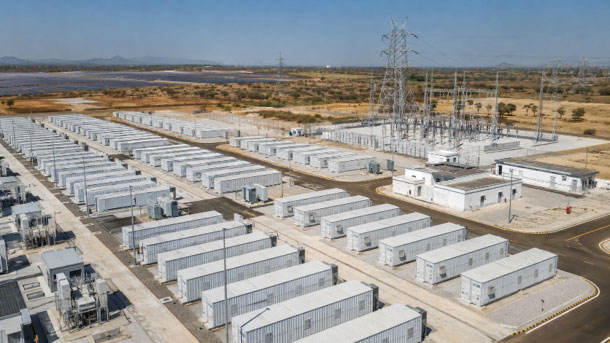 Utility-scale battery storage can help convert variable renewable generation into dispatchable energy.
India’s Energy Transition Is Becoming an Integration Challenge
India has entered a new phase of power-sector development. The central question is no longer only how rapidly renewable capacity can be added, but how effectively variable generation can be integrated into a system that must deliver electricity continuously, safely and at the required quality.
According to the Ministry of New and Renewable Energy’s Programme/Scheme-wise Physical Progress data, India added 14.33 GW of solar capacity during FY 2026-27 through 31 July 2026, taking cumulative installed solar capacity to 164.59 GW. Installed wind capacity stood at 58.14 GW as of the same date. This scale of renewable deployment increases the need for flexibility across generation, networks, demand and storage.
Source: Ministry of New and Renewable Energy (MNRE), Programme/Scheme-wise Physical Progress, data as of 31 July 2026. https://mnre.gov.in/en/physical-progress/
The Central Electricity Authority’s National Electricity Plan, as summarized by MNRE, projects an energy-storage requirement of 82.37 GWh in 2026-27, including 34.72 GWh from BESS. By 2031-32, the projected requirement rises to 411.4 GWh, including 236.22 GWh from BESS. These projections indicate that storage is moving from a limited pilot role toward a core system-planning requirement.
What BESS Contributes to the Power System
A Battery Energy Storage System is more than a collection of battery cells. A deployable BESS combines battery modules, thermal management, power-conversion systems, controls, protection equipment, fire-safety systems and an energy-management platform. Its value depends on how these elements are engineered for the intended duty cycle and operating environment.
| BESS function | Operational value |
| Renewable energy firming | Stores surplus solar or wind generation and dispatches it when output falls or demand rises. |
| Peak management | Reduces exposure to peak-demand periods by shifting stored energy to higher-load windows. |
| Fast grid response | Provides rapid active-power response for frequency regulation and short-duration balancing. |
| Power-quality support | Can support voltage management and smooth short-duration fluctuations when correctly engineered. |
| Resilience and continuity | Supports critical loads during grid disturbances when designed with appropriate islanding, controls and protection. |
| Capacity and infrastructure deferral | May reduce or defer selected network or generation upgrades where load profiles and regulation permit. |
The commercial case for a project therefore cannot be based on battery capacity alone. It must be assessed against the required power rating, discharge duration, cycling profile, availability target, degradation assumptions, operating temperature, grid-code requirements, land constraints and revenue or savings mechanisms.
Why BESS Deployment Is Accelerating in India
1. A larger requirement for system flexibility
Solar generation is concentrated in daylight hours, while system demand frequently remains high after sunset. Wind generation also varies across seasons and weather conditions. Storage can shift energy across time and respond quickly to imbalances, complementing transmission expansion, flexible generation and demand-side management.
2. Policy and regulatory support
India has introduced multiple enabling measures for storage, including Viability Gap Funding arrangements for BESS, operational guidelines for state components, an advisory on co-locating storage with solar projects, and provisions relating to inter-state transmission-charge waivers for eligible energy-storage systems. Project developers must verify the latest scheme conditions and commissioning timelines before relying on any incentive in a financial model.
3. Growing industrial demand for resilience
Manufacturing plants, data centres, commercial campuses, mines and infrastructure sites increasingly evaluate energy systems against uptime, power quality, fuel exposure and decarbonisation goals. BESS can be configured to support critical loads and peak management, but only when the electrical architecture, protection logic and operating strategy are designed around the facility’s actual load profile.
4. Maturing project economics and technology
Declining battery costs, higher manufacturing scale and improving system integration have expanded the range of viable use cases. However, headline battery prices do not represent total project economics. Engineering, balance-of-system equipment, safety compliance, land, interconnection, augmentation, warranties, operations and end-of-life obligations must all be included in lifecycle assessment.
Hybrid energy systems can coordinate solar, storage, grid supply and conventional generation around a facility’s operating priorities.
The Future Is Hybrid: Storage Complements Other Power Sources
BESS should not be positioned as a universal replacement for conventional generation. Storage is an energy-shifting and fast-response resource; it must first be charged, and its duration is finite. Engines, grid supply, renewables, fuel cells and storage therefore perform different but complementary roles.
In a well-designed hybrid system, renewable generation can reduce energy cost and emissions; BESS can manage short-duration variability, peak demand and transitions; the grid can supply normal or balancing power; and engine- or fuel-cell-based generation can provide extended-duration support where required. An energy-management system coordinates these assets according to load, availability, tariff, state of charge and operating priority.
Weichai New Energy Solutions: From Individual Assets to Integrated Energy Systems
Weichai’s New Energy Solutions portfolio extends the Group’s power-system capabilities into energy storage, hydrogen fuel cells, solid oxide fuel cells and integrated energy architectures. The official Weichai product platform identifies energy-storage system solutions based on high-safety, long-life blade cells developed for storage applications, with emphasis on cycle life, safety and reliability.
Weichai has also presented an integrated microgrid solution that combines hybrid power generation, mobile photovoltaic generation, energy storage, integrated storage-and-charging equipment and solid oxide fuel cell technology. The objective is to coordinate multiple energy sources within a deployable system for applications such as industrial parks, data centres, remote operations and infrastructure requiring high reliability.
For customers in India, the practical value lies in solution engineering: defining the load and resilience requirement; selecting the appropriate generation and storage mix; integrating power conversion, controls and protection; and planning service support across the system lifecycle. Final configurations, product availability, local certification and performance commitments must be confirmed for each project and application.
A Practical Evaluation Framework for BESS Projects
| 1. Define the operating problem | Specify whether the priority is renewable firming, demand-charge reduction, backup support, power quality, grid services or a combination. |
| 2. Analyse the load and generation profile | Use interval data, peak-demand patterns, outage history, renewable forecasts and critical-load segmentation. |
| 3. Size power and energy separately | Determine MW requirement from instantaneous load and response needs; determine MWh from required discharge duration and usable state-of-charge range. |
| 4. Engineer safety and compliance | Address cell chemistry, thermal management, fire detection and suppression, separation distances, emergency response, earthing, protection and applicable codes. |
| 5. Model lifecycle economics | Include degradation, augmentation, efficiency losses, warranty limits, maintenance, insurance, financing and end-of-life obligations. |
| 6. Plan controls and integration | Define operating modes, grid-forming or grid-following requirements, islanding logic, interfaces and cybersecurity responsibilities. |
Looking Ahead
India’s BESS market will be shaped not only by the volume of capacity installed, but by the quality of project design, safety engineering, operational performance and lifecycle service. Storage projects that begin with a clearly defined use case and an integrated system architecture will be better positioned to deliver dependable value.
Weichai New Energy Solutions brings together capabilities across storage, fuel cells, microgrids and conventional power so that customers can evaluate energy reliability as a complete system rather than as a single-product decision. The priority for the next phase is disciplined application engineering: matching technology to operating need, validating performance assumptions and building serviceability into the design from the outset.
| PROPOSED PULL QUOTE – FOR APPROVAL“The value of BESS is realised when storage is engineered as part of a complete power system – aligned to the customer’s load, other sources of power, resilience requirements and long-term operating economics”– Alok Joshi, CEO – Weichai APAC |
About the Author

Proposed author profile: Alok Joshi is CEO - Weichai APAC and oversees Weichai's business across the Asia-Pacific region, including power-generation and new-energy solutions.