

How CEV Stage V Engines Improve Excavator Performance and Emission Control
-
21st September
-
Chayan
-
CEV Stage V Engine
Excavator Performance
Excavator Emission Control
Benefits of CEV Stage V Engine
Weichai confirmed its new engine range meets CEV Stage V emission norms directly, through Gurunath Kulkarni, VP India Operations, who stated the company’s new range of engines complies with CEV Stage V and that Weichai anticipates reaching annual sales of 6,000 units on this range. That statement matters here because it points to something specific: Weichai added a Diesel Particulate Filter to engines that already ran DOC and SCR after-treatment, and that single addition was what closed the gap to CEV Stage V compliance.
This piece looks at what changed inside these excavator engines and why the change improved both performance and emission control at the same time, rather than trading one for the other.
The Regulatory Push Behind This Shift
CEV Stage V didn’t arrive as a minor update. According to Ritu Goswami, AVP and Sector Head of Corporate Ratings at ICRA, a sizeable volume of equipment in India running on sub-37 kW diesel engines jumped straight from Stage III to Stage V, a transition ICRA describes as bringing India in line with leading global markets. The Indian CEV industry itself grew to 1.36 lakh units in FY2024, expanding at roughly 12 percent annually between FY2015 and FY2024, according to ICRA’s data.
That growth is exactly why emission control on excavator engines couldn’t stay static. More machines on the ground meant more exhaust in the air, and regulators responded accordingly.
Combustion Comes First, Before Any After-Treatment
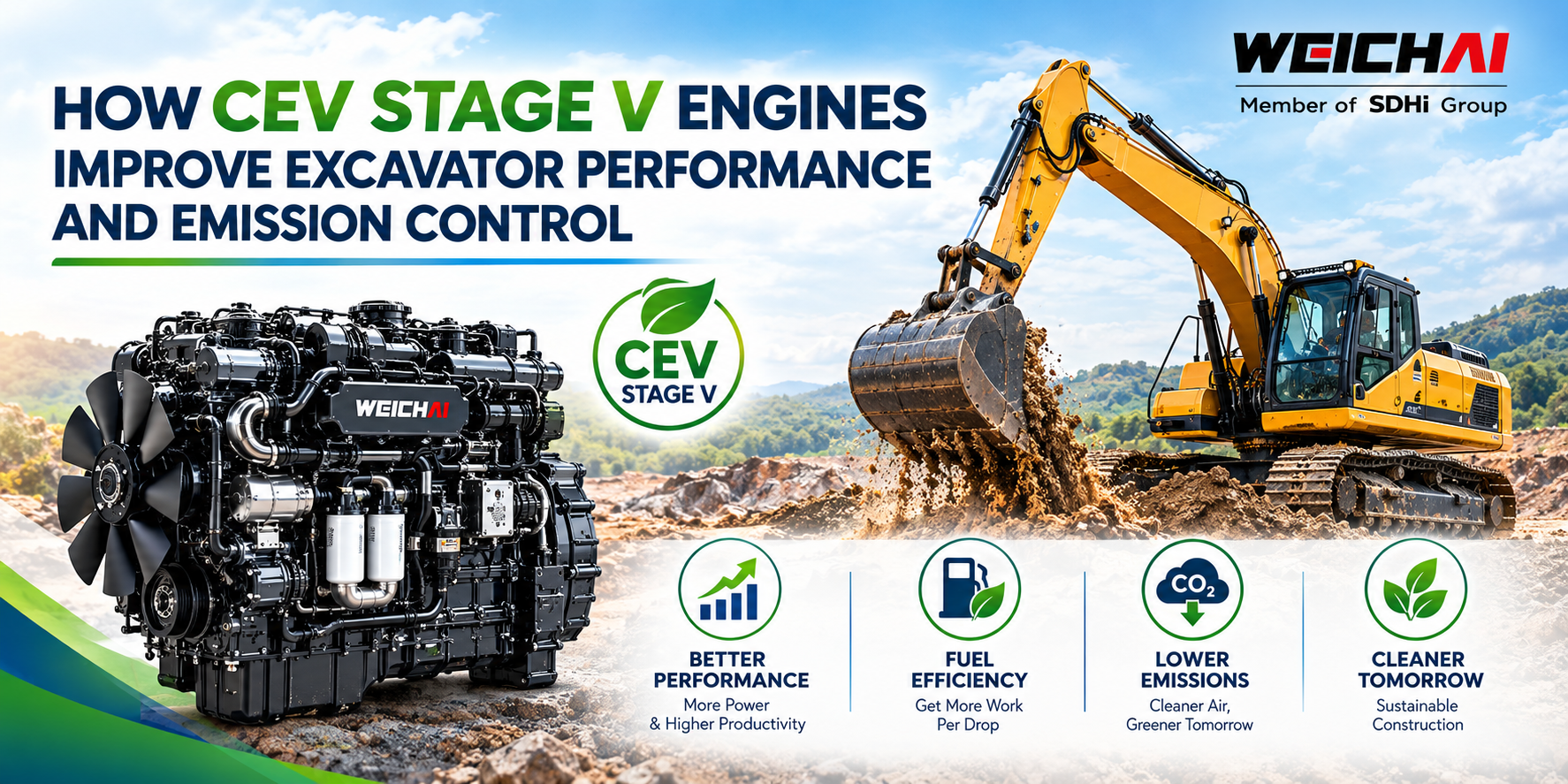
An excavator engine built for CEV Stage V starts with cleaner combustion, not just filtration bolted on afterward. Weichai’s WP9H, sized for 30T to 40T excavators and 25T to 55T cranes, runs an active combustion design paired with a High Pressure Common Rail System. That system atomizes fuel into finer droplets before injection, and finer droplets burn more completely.
The WP4.6N takes the same approach at a smaller scale. Its Common Rail technical route delivers high-pressure fuel atomization suited to loaders, excavators, and rollers, with a rated displacement of 4.6 liters. Less unburned fuel escaping through the exhaust means less work left for the after-treatment stage that follows.
What DPF Added That DOC and SCR Alone Couldn’t Cover
Kulkarni’s comment is worth returning to directly here, because it explains the actual engineering gap. Weichai’s engines already ran DOC and SCR before this transition. DOC handles carbon monoxide and unburnt hydrocarbons. SCR converts nitrogen oxides into nitrogen and water vapor using a catalyst.
Neither of those systems traps solid particulate matter, soot, effectively enough on its own to meet CEV Stage V limits. That’s the specific job a Diesel Particulate Filter does: physically catching soot before it exits the tailpipe. Adding DPF to the existing DOC and SCR setup closed that particulate gap, and Weichai’s WP12, WP9H, and WP4.6N now run all three systems together, alongside cooled Exhaust Gas Recirculation to reduce NOx formation before combustion even finishes.
Torque and Power Output Didn’t Drop to Get There
A common assumption is that tighter emission limits cost an engine some of its power. The numbers on Weichai’s excavator engines don’t support that. The WP9H delivers up to 330.98 HP and 1600 N·m of torque. The WP12, built for larger excavators, is rated for a maximum torque of 1,000 N·m and carries a service life of up to 30,000 hours.
Fuel consumption stayed controlled too. The WP9H runs under 190 g/kW·h even across its full 1,800,000 km or 30,000-hour rated lifespan. None of these figures suggest a compromise. They suggest the combustion and turbocharging work described above did what it was meant to do, keep output steady while emissions fell.
Site Conditions Test Whether Any of This Actually Holds
Excavators don’t run in controlled environments. Weichai’s off-road engines are rated to operate from -35°C to 50°C, and the WP9H specifically holds performance up to 4,700 meters of altitude. That range matters for CEV Stage V engines in particular, since after-treatment systems like DPF and SCR need consistent exhaust temperature to function correctly. An engine that loses emission control the moment it hits altitude or extreme cold isn’t actually compliant in the field, whatever its rated numbers say on paper.
OEM Rollout Confirms the Direction of the Industry
This shift isn’t isolated to one manufacturer. CASE Construction Equipment rolled out BS CEV Stage V compliant machines in the NCR region, including its CX220C LC hydraulic excavator, describing the changes as revised engine and system configurations that meet emission standards without affecting output. That pattern, tighter emissions without a performance penalty, matches exactly what Weichai’s WP9H and WP12 data show.
Frequently Asked Questions
1. Does CEV Stage V reduce excavator engine power?
No. Weichai’s WP9H and WP12 maintain their rated torque and horsepower figures while running full CEV Stage V after-treatment, according to published specifications and company statements.
2. What specific change made Weichai’s engines CEV Stage V compliant?
Adding a Diesel Particulate Filter to engines that already ran DOC and SCR closed the remaining gap, according to Gurunath Kulkarni, VP India Operations at Weichai India.
3. How does DPF work alongside SCR and DOC in an excavator engine?
DOC reduces carbon monoxide and hydrocarbons, SCR converts nitrogen oxides into nitrogen and water, and DPF physically traps soot. Each targets a different pollutant in the exhaust stream.
4. Can excavator engines maintain emission control at high altitude?
Weichai’s WP9H is rated for altitudes up to 4,700 meters, and its off-road range operates from -35°C to 50°C, conditions where after-treatment systems need to keep functioning consistently.
5. How large is India’s CEV market, and why does this transition matter at scale?
India’s CEV industry reached 1.36 lakh units in FY2024, growing at roughly 12 percent annually since FY2015, according to ICRA. That volume is why tighter emission standards apply broadly across the industry, not to a small segment of machines.