

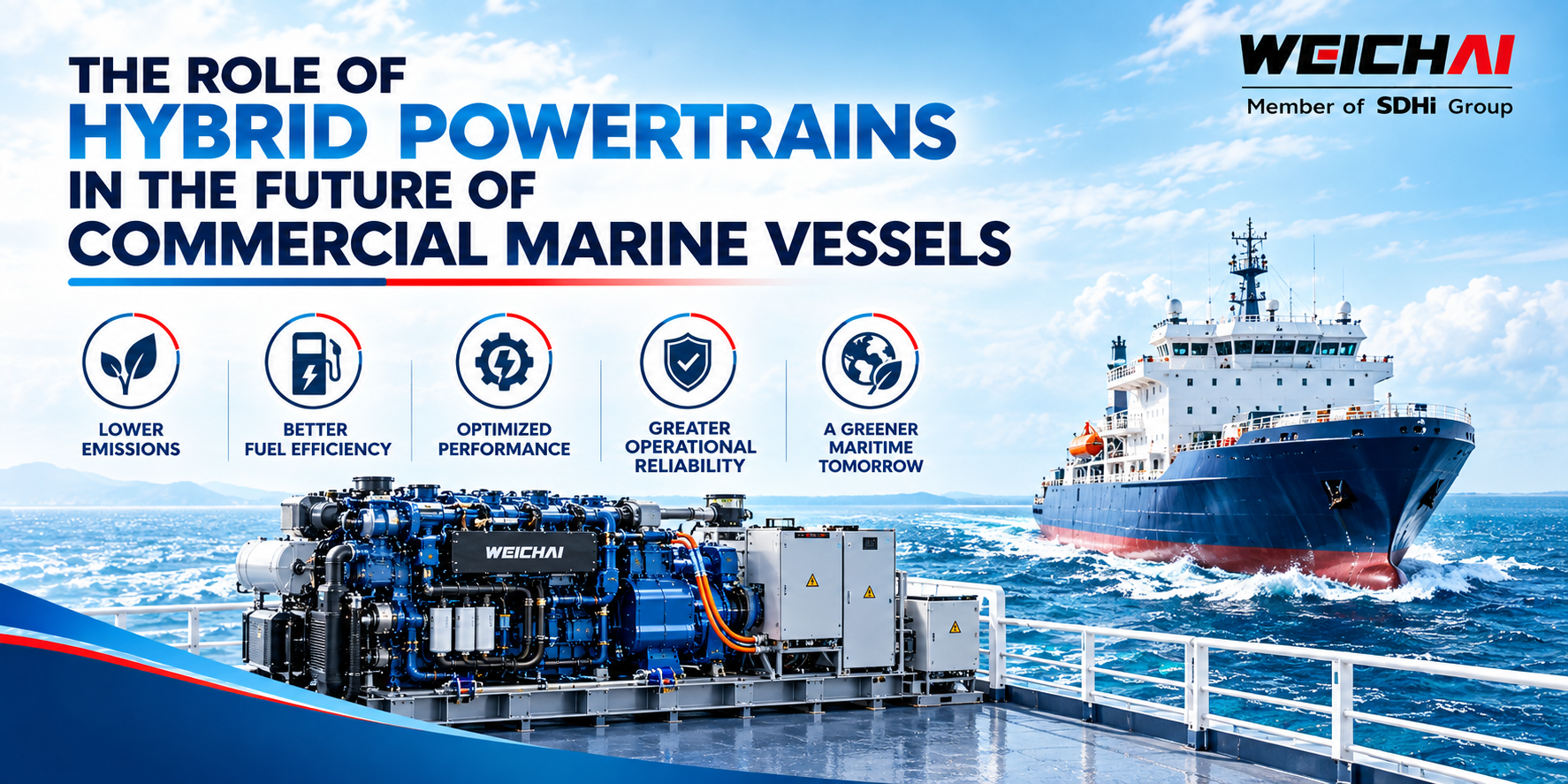
The Role of Hybrid Powertrains in the Future of Commercial Marine Vessels
-
28th September
-
Chayan
-
hybrid powertrain
commercial marine engine
A commercial vessel does not operate at one power level throughout its working cycle. A ferry needs high propulsion power during departure and acceleration, lower power during cruising, and controlled output while approaching a berth. A tug can move from standby to high-load towing within a short period. A harbour workboat may spend substantial time manoeuvring before it reaches its next operating location.
That variation is changing how marine propulsion systems are designed.
A hybrid powertrain allows the vessel to combine conventional engine power with electric propulsion and battery energy storage. The purpose is not simply to add a battery to an existing propulsion system. It is to distribute the vessel’s power demand between different energy sources according to the operating condition.
For commercial marine vessels, that creates a new way to approach propulsion efficiency, engine utilisation and future emission requirements.
What Is a Hybrid Powertrain?
A hybrid powertrain combines two or more propulsion or energy sources within the same vessel.
A conventional marine propulsion system may use a diesel engine, gearbox, shaft and propeller to convert fuel energy into propulsion. A hybrid system adds electrical components such as an electric motor, battery energy-storage system, power electronics and an energy-management system.
The arrangement can take different forms.
In a parallel hybrid system, both the engine and electric motor can contribute to propulsion. In a series hybrid system, the engine drives a generator and the electric motor provides the propulsion power. Some vessel designs can combine elements of both architectures.
The choice depends on how the vessel operates.
Why Commercial Marine Vessels Are Moving Towards Hybrid Propulsion
The main issue is not the availability of electric motors or batteries. It is the way vessels use power.
A commercial marine engine may be sized to provide the power required during demanding operating conditions. But the vessel may spend much of its working cycle below that maximum requirement.
During low-speed operation, manoeuvring or standby conditions, the engine may have substantially less work to perform. During acceleration or towing, the power requirement can rise sharply.
A hybrid powertrain gives the propulsion system another way to manage these changes.
The electric motor can provide additional power when demand rises. The battery can supply electrical energy during selected low-load operating periods. The engine can remain responsible for sustained propulsion where its range and energy density provide an advantage.
This division of work is one of the main reasons hybrid systems are being considered for future commercial vessels.
How Does a Hybrid Powertrain Work?
A hybrid marine propulsion system brings several components into one controlled power network.
The commercial marine engine provides the primary energy source in many configurations. Depending on the architecture, it can deliver mechanical propulsion or drive a generator to produce electricity.
The battery stores electrical energy. The electric motor converts that energy into mechanical propulsion. Power converters and inverters regulate electrical energy between the battery, motor, generator and vessel electrical system.
The energy-management system coordinates the complete arrangement.
When the vessel requires additional propulsion power, the electric motor can assist the engine. When propulsion demand falls, the system can reduce engine contribution and use stored electrical energy where the vessel architecture allows it.
This makes control strategy as important as hardware selection.
A hybrid system has to decide when to use engine power, when to use battery power and when both should operate together. Mis-matched controls can reduce the value of an otherwise capable hybrid system.
Where Is Hybrid Propulsion System Commonly Used In?
Hybrid propulsion is particularly suitable for vessels that experience frequent changes in propulsion demand. Key applications include:
- Ferries: Repeated cycles of acceleration, cruising, deceleration and docking create opportunities for electric propulsion to support the engine.
- Tugboats: Towing and vessel-assistance operations can require high propulsion power, while standby and manoeuvring require considerably less.
- Pilot boats: Frequent short-distance trips and repeated changes in speed can make battery-assisted propulsion suitable for selected operating conditions.
- Harbour craft: Low-speed manoeuvring, docking and standby operations can allow electric propulsion to handle part of the vessel’s power demand.
- Workboats: Variable workloads and frequent movement between operating locations can create opportunities for hybrid power management.
- Offshore service vessels: Transit, station keeping, standby and equipment-support operations can produce different propulsion loads throughout the working cycle.
What Will Happen to the Commercial Marine Engines?
Hybridisation does not remove the need for a commercial marine engine.
In many vessel applications, the engine remains the main source of sustained power. It provides the range required for longer operations and can supply the high energy demand that would require an impractically large battery if handled entirely through electric propulsion.
Its role within the powertrain changes.
Instead of responding to every short-duration variation in propulsion demand, the engine can work with the electric motor and battery. The electrical system can handle selected transient loads while the engine supplies sustained power.
This can improve the way the complete propulsion system responds to changing demand.
For example, a battery and electric motor can provide additional short-duration propulsion assistance while the engine remains responsible for sustained operation.
So, What Role Will Hybrid Powertrains Play in Marine Emission Reduction?
Hybrid powertrains can reduce engine operation during low-speed, manoeuvring and docking periods. The electric motor can use stored battery energy when full engine output is not required.
Lower Engine Use
Battery power can handle selected low-load operations, reducing the need to run the commercial marine engine throughout the entire operating cycle.
Lower Local Emissions
Electric propulsion produces no exhaust emissions at the point of use. This can be useful during harbour operations and docking, where local emissions are a concern.
Supporting Decarbonisation
Hybrid propulsion is one part of the wider marine decarbonisation pathway. It can work alongside alternative fuels, shore power and other energy-efficiency technologies.
The International Maritime Organization’s 2023 GHG Strategy targets net-zero greenhouse-gas emissions from international shipping by or around 2050. It also sets a 2030 target for zero- or near-zero-GHG technologies, fuels and energy sources to account for at least 5% of shipping’s energy use, while striving for 10%.
Preparing for Future Energy Systems
A hybrid powertrain allows the commercial marine engine and electric propulsion system to operate together. This provides flexibility as battery technology, charging infrastructure and alternative marine fuels develop.
The Long-Term Vision for Hybrid Powertrains in Commercial Marine Propulsion
The future of marine propulsion will move towards systems that can combine multiple energy sources without compromising vessel performance. Hybrid powertrains offer commercial marine vessels a practical path towards more flexible and efficient propulsion.
They can bring together a commercial marine engine, electric motor, battery storage, shore power and future alternative-fuel technologies within one propulsion architecture.
So, the long-term outlook is therefore positive. Hybrid propulsion can give the marine industry a foundation for adopting new energy technologies while retaining the range, power and operational reliability that commercial vessels require.
FAQs
1. How does a hybrid powertrain differ from a conventional marine propulsion system?
A conventional system relies primarily on the engine for propulsion. A hybrid powertrain combines a commercial marine engine with an electric motor, battery system and power electronics, allowing propulsion power to come from the engine, the electrical system, or both.
2. Does a hybrid powertrain always operate on battery power?
No. Battery operation depends on the vessel’s design and operating requirements. In many systems, the commercial marine engine remains the primary source of sustained power, while the battery provides propulsion assistance or supports selected low-load operations.
3. Why are vessel duty cycles important when selecting a hybrid powertrain?
The duty cycle determines how often the vessel accelerates, cruises, manoeuvres, idles or operates under high load. These conditions determine where battery-electric propulsion can provide useful support and help engineers size the engine, motor and battery correctly.
4. Can hybrid propulsion be used in long-distance commercial vessels?
Yes, but the suitability depends on the vessel’s power and range requirements. Long-distance vessels may continue to rely heavily on the commercial marine engine because batteries can add substantial weight and space requirements when large amounts of energy are needed for extended propulsion.
5. What determines the emission reduction potential of a hybrid marine vessel?
It depends on how much engine operation the hybrid system can replace or reduce, the vessel’s operating profile, battery capacity, charging method and electricity source. A hybrid system therefore does not have a fixed emission-reduction value across all vessel types.