

The Engineering Evolution of CEV Stage V Engines: What’s New Under the Hood?
-
3rd August
-
Chayan
-
CEV Stage V Engines Evolution
Evolution of CEV Stage V Engines
Pop the hood on a Weichai off-road engine today, and it looks nothing like its CEV Stage III predecessor. More sensors. More plumbing around the exhaust. A control unit doing work that used to happen mechanically. None of this happened for show — every change traces back to one goal: meeting CEV Stage V without giving up the power these machines are built for.
Here’s how that engineering journey actually unfolded.
It Starts With How Fuel Burns
The first place engineers looked was combustion itself. If fuel burns more completely inside the cylinder, less waste escapes through the exhaust. That sounds simple. Getting there wasn’t.
Weichai reworked piston bowl geometry and injection timing across engines like the WP12 and WP9H. Small adjustments to swirl pattern, compression ratio, and spray angle added up to a combustion process that behaves very differently from earlier CEV generations. Less soot forms in the first place — that’s the whole point.
Then Fuel Delivery Had to Catch Up
Cleaner combustion needs precise fuel delivery, and older mechanical injection systems couldn’t keep pace. High-pressure common rail systems took over across Weichai’s non-road engine range instead.
What changes with higher pressure? Fuel breaks into finer droplets. Finer droplets burn faster, more evenly, and more completely. Operators notice it too — throttle response sharpens, which matters when equipment needs quick power on demand at a job site.
Exhaust Treatment Became Non-Negotiable
Combustion improvements alone don’t clear CEV Stage V limits. Something has to catch what’s left over.
Three systems handle that job now:
- Diesel Particulate Filter (DPF) — physically traps soot before it exits the exhaust
- Selective Catalytic Reduction (SCR) — injects fluid into the exhaust stream, converting nitrogen oxides into nitrogen and water vapor
- Cooled Exhaust Gas Recirculation (EGR) — sends part of the exhaust back through the engine, dropping combustion temperature and cutting NOx formation at the source
Models like the WP7 and WP4.6N carry all three as standard equipment. Not an add-on. Not an upgrade package. Just how these engines get built now.
Electronics Took Over Jobs Mechanics Used to Do
Older diesel engines ran mostly on mechanical logic — fixed timing, fixed fuel quantity, adjusted only within narrow ranges. CEV Stage V engines don’t work that way anymore.
Sensors track combustion temperature, exhaust flow, and fuel pressure continuously. The electronic control unit reads all of it and adjusts injection timing and fuel quantity on the fly. Load changes, conditions shift, and the engine responds in real time — a level of responsiveness that simply didn’t exist a decade ago.
Turbocharging Got Smarter Too
Air-fuel ratio matters just as much as fuel quality. Weichai’s CEV Stage V engines use turbocharging systems with tighter boost control, keeping that ratio in check across changing loads.
Why does this matter on a job site? Because equipment rarely runs at one constant load all day. A turbo that adapts well keeps power steady whether the machine is idling or working flat out, without emissions spiking in between.
None of It Matters Without Durability
Here’s the question that decides whether any of this holds up in practice: can these systems survive Indian job sites? Heat, dust, altitude swings, long duty cycles — none of that goes easy on an engine.
Weichai runs extended testing against exactly these conditions before an engine reaches the market. DPF and SCR components in particular need to keep working reliably after thousands of operating hours — not just in a lab, but on an actual quarry floor or highway project.
One Standard, Two Names
Bharat Stage V and CEV Stage V refer to the same technical requirements, just labeled differently depending on where the term shows up. Whichever name appears on the paperwork, the engineering underneath stays identical — same combustion redesign, same fuel system, same after-treatment stack.
Where This Leaves Weichai’s Engine Range
The WP4.6N, WP8, WP10H and WP13 all carry this evolution forward, spanning construction, mining, road machinery, and agriculture. Spec sheets might show similar horsepower numbers to older models. What’s actually happening inside the engine tells a completely different story now.
Bottom Line
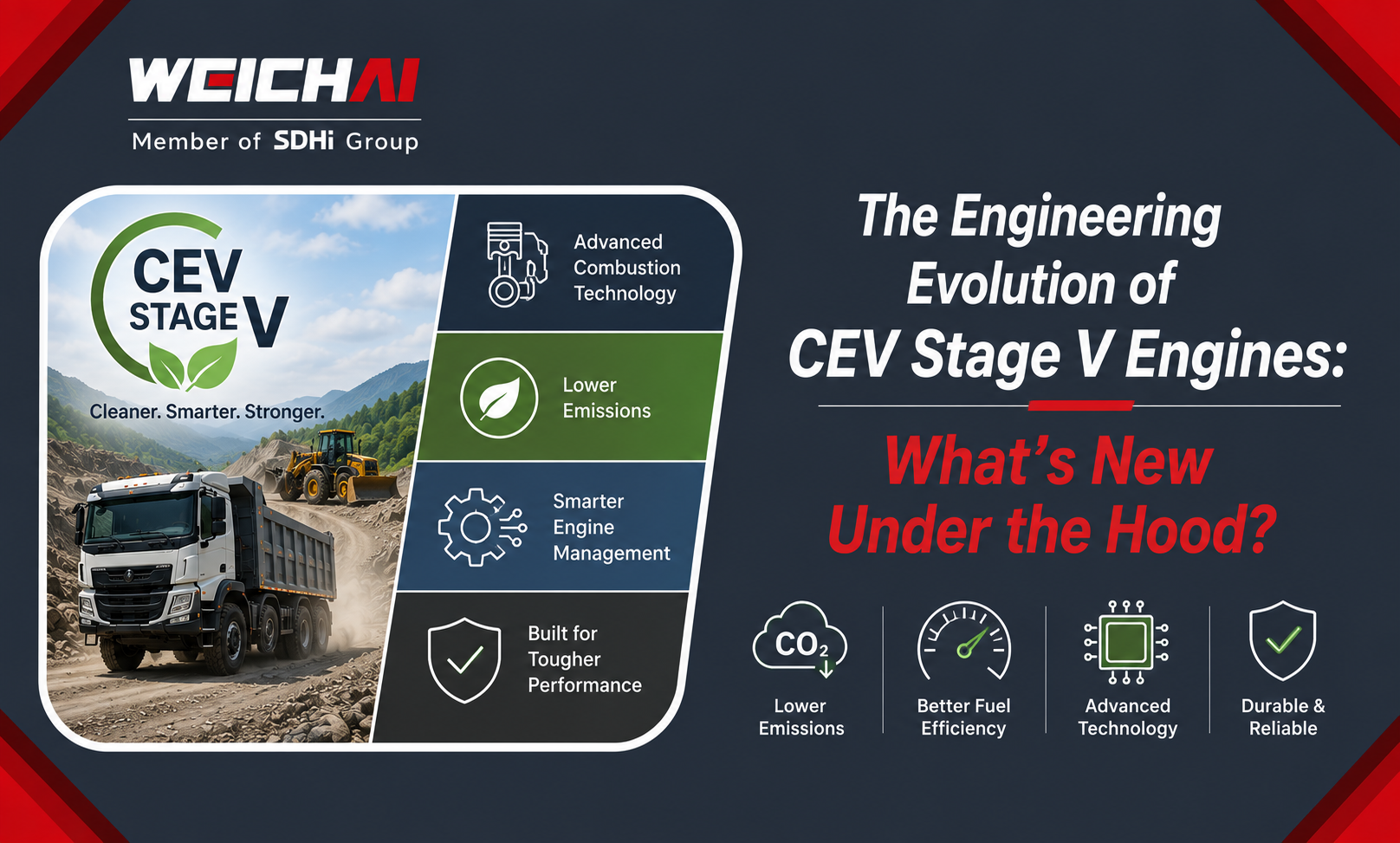
CEV Stage V didn’t arrive as a small tweak. It forced a rebuild — combustion, fuel delivery, exhaust treatment, and electronics, all reworked together. What came out the other side is an engine range built for cleaner running without backing off the power and durability Indian job sites have always demanded from Weichai.
Frequently Asked Questions
1. What changed inside CEV Stage V engines?
Combustion design, fuel injection, after-treatment systems, and electronic controls all moved together — not as separate upgrades, but as one connected redesign.
2. Do electronic control units make these engines harder to maintain?
Not really. They actually help catch issues earlier by monitoring performance continuously, which can prevent bigger problems down the line.
3. Does meeting CEV Stage V mean losing engine power?
No. Weichai engineers these engines to hold power output steady while combustion and after-treatment improvements handle the emissions side.
4. How does Weichai test engines for Indian conditions?
Through extended testing that covers heat, dust, altitude changes, and long duty cycles typical of Indian construction and mining sites.
5. Is the engineering different between Bharat Stage V and CEV Stage V?
No. Both terms describe the same standard, so the technical requirements and engineering work stay the same.