


CEV Stage III vs CEV Stage V: What Changed in Off-Road Engine Technology?
-
1st August
-
Chayan
-
CEV Stage V Off Road Engine Technology
CEV Stage III vs CEV Stage V
CEV Stage III Off Road Engine Technology
Anyone who’s spent time around construction equipment over the past few years has noticed the changes without even trying. Engines within the vehicle sound different now. They run cleaner, smoke far less, and carry a lot more electronics under the hood than they did even five years ago. This shift didn’t happen gradually or by accident — it’s the direct result of India moving from CEV Stage III to CEV Stage V, and the gap between those two stages is bigger than most people in the industry realize.
This blog breaks down what actually separates the two standards, why the transition happened the way it did, and what it means for off-road engines out on real job sites.
Where CEV Stage III Left Off
CEV Stage III had a solid run. Introduced years ago and borrowing heavily from US Tier 2 and Tier 3 emission frameworks, it stayed in place across construction, mining, and agricultural machinery for over a decade. Engines built to this standard did what was asked of them — they kept pollution in check by the standards of that era. But the era has since moved on, and so have air quality expectations.
Under Stage III, exhaust treatment stayed fairly basic. Most engines leaned on combustion tuning rather than dedicated after-treatment systems to hit their limits. That approach worked for a while, but it left plenty of room for improvement, especially as air quality concerns grew louder across Indian cities and industrial corridors.
Why India Skipped an Entire Generation
Here’s the part that tends to surprise people outside the industry: India didn’t move from Stage III to Stage IV the way you’d expect a normal regulatory progression to work. For smaller engine categories, the jump went straight from Stage III to Stage V — skipping an entire intermediate stage that other countries worked through gradually.
This was a drastic change for manufacturers. There was no gentle runway here, no chance to adjust in stages the way markets elsewhere got to. Engineering teams had to redesign combustion systems, fuel delivery, and exhaust after-treatment almost from the ground up, and do it within a tight compliance timeline. That’s a demanding ask for any industry — and a particularly tough one for machines built to survive rough job sites for years without failing.
The Real Differences Between Stage III and Stage V
So what changed under the hood? More than most people expect.
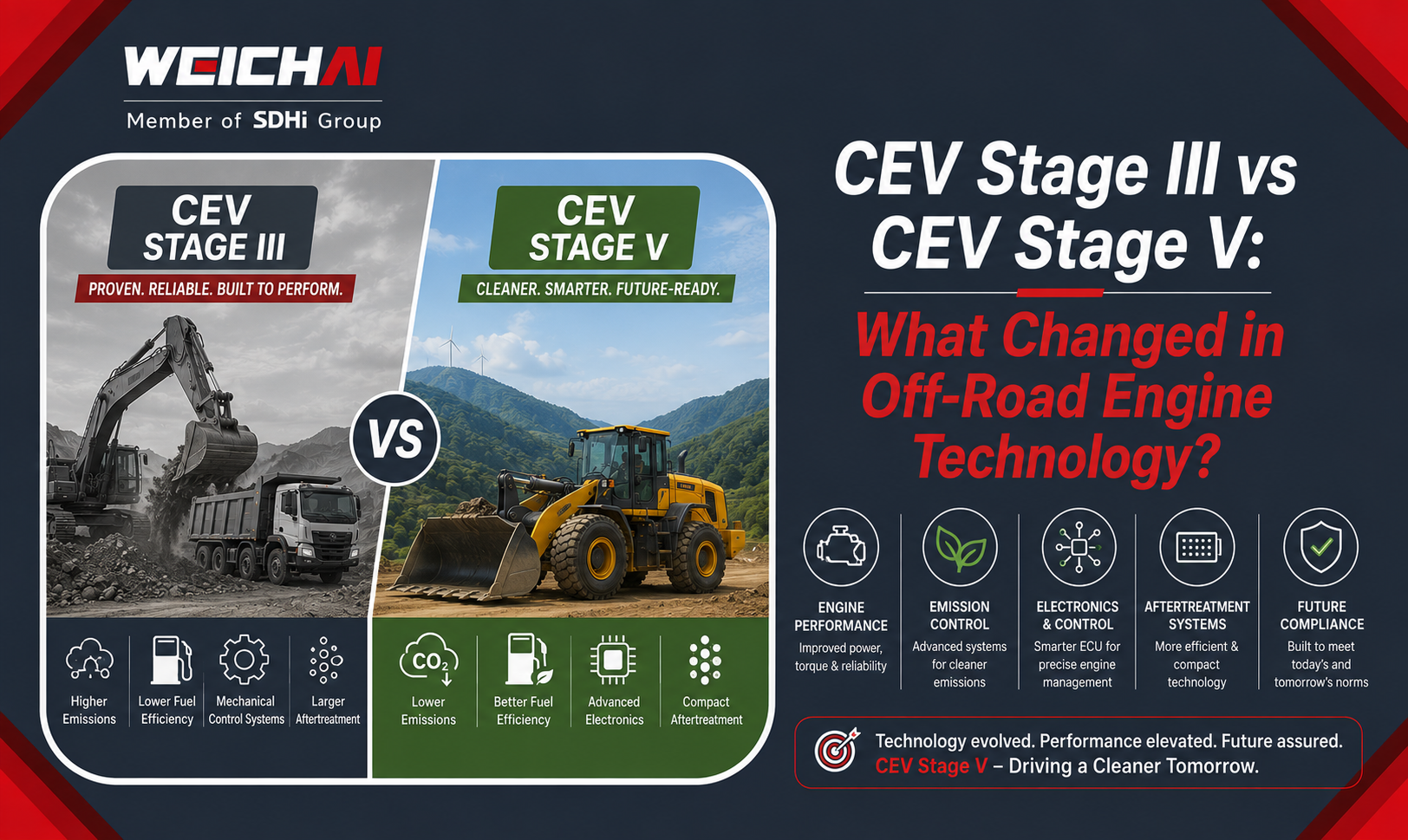
- Emission limits tightened sharply. Particulate matter, nitrogen oxides, hydrocarbons, and carbon monoxide all had to drop well below Stage III thresholds — a shift that forced engineers to rethink how these engines burn fuel in the first place.
- After-treatment went from optional to essential. Stage III engines could often meet emission targets through combustion tuning alone. Stage V engines can’t. Diesel Particulate Filters, Selective Catalytic Reduction, and cooled exhaust gas recirculation stopped being add-ons and became standard equipment.
- Fuel systems got a real upgrade. Older fuel delivery methods simply weren’t precise enough for the new limits, so high-pressure common rail systems took over. Fuel gets atomized more finely now, which means it burns more completely and more efficiently.
- Electronic control expanded significantly. Stage V engines rely far more heavily on sensors and electronic management to keep combustion and emissions in range across varying loads. Stage III engines never needed that level of real-time monitoring.
Put simply: Stage III engines were built to meet the rules of their time. Stage V engines were built for a much tighter rulebook, and that difference shows up in nearly every major component.
What This Means Out on the Job Site
None of this stays theoretical once the engine hits real working conditions. Off-road equipment under CEV Stage V still needs to deliver the power and torque operators expect — just with a fraction of the emissions older engines produced. That’s not a small engineering feat to pull off.
Take Weichai’s off-road lineup as a working example. Engines like the WP 4.6N, WP8, WP10H and WP13 power excavators, loaders, and other heavy machinery across construction, mining, road building, and farming. Bringing these engine families up to CEV Stage V standard meant reworking combustion design and exhaust treatment while holding onto the durability these engines are known for. Power output couldn’t slip. Reliability couldn’t slip. Only the emissions were allowed to drop.
Bharat Stage V and CEV Stage V — Worth Repeating
This comes up often enough that it’s worth restating clearly: Bharat Stage V and CEV Stage V refer to the exact same set of rules for construction equipment. “Bharat Stage” is India’s broader naming convention for emission standards across vehicle categories, and “CEV” simply specifies that the standard applies to construction equipment vehicles rather than road vehicles. Same rulebook — just a different label depending on who’s writing about it.
Why This Jump Matters Beyond Just Compliance
It would be easy to write this off as regulatory box-checking. It isn’t. Engines built to CEV Stage V standards tend to run more efficiently overall, not just cleaner. Better fuel atomization and tighter combustion control often translate into meaningfully better fuel economy over the life of a machine — something that matters a great deal to fleet owners tracking operating costs closely.
There’s a durability angle here too. Modern after-treatment systems, when properly maintained, don’t shorten engine life. If anything, the added electronic monitoring tends to catch developing issues earlier, before they turn into expensive repairs down the line.
Final Word
The move from CEV Stage III to CEV Stage V reshaped off-road engine technology in India, and it happened on a tighter timeline than most industries would have preferred. But the outcome is engines that run cleaner, work just as hard, and hold up to the same demanding conditions construction and mining sites have always thrown at them. For anyone buying or operating this equipment, understanding that shift makes the next purchase decision considerably easier.
Frequently Asked Questions
What’s the main difference between CEV Stage III and CEV Stage V?
Emission limits under Stage V are far stricter. As a result, engines now need systems like DPF and SCR just to stay compliant — something most Stage III engines managed without.
Did India go through CEV Stage IV before Stage V?
Not for smaller engine categories. Many jumped directly from Stage III to Stage V, skipping an intermediate step that other markets went through.
Are CEV Stage V off-road engines less powerful than older ones?
Not really. Manufacturers pushed to keep power output the same or better, all while bringing emissions down by a wide margin.
Is CEV Stage V the same as Bharat Stage V?
Yes. Both terms point to the same emission standard for construction equipment.
Do CEV Stage V engines need more maintenance?
They need proper upkeep of after-treatment components, but that doesn’t translate to significantly more maintenance when handled by a reliable manufacturer.